 1inch
1inch
1inch Terminal uses slippage tolerance to set a minimum market-swap output
- updated1inch Terminal lets you adjust market-swap slippage tolerance to define the minimum acceptable amount of the output token. A tighter tolerance leaves less room for adverse price movement before execution. A wider tolerance accepts more movement. The contract reverts a swap that falls below its required minimum, and the failed transaction can still consume gas.
Terminal supports Market and Limit modes on supported Ethereum Virtual Machine (EVM) networks. The Market form combines amount, slippage, and gas controls. Their effects remain separate: the amount influences the quote, slippage limits accepted deterioration, and gas settings affect transaction processing.
Key takeaway: Reducing the swap amount can address negative price impact; widening slippage tolerance changes the output deterioration that you accept.
How does slippage tolerance differ from price impact?
Slippage tolerance caps deterioration relative to a swap quote; price impact describes the effect that the swap itself has on the exchange rate.
Price impact already affects the quote
A large amount relative to available liquidity can worsen the rate for the selected pair. The quoted output reflects that trade size. Aggregation can spread a swap across available liquidity sources, reducing concentration in one pool. That possibility depends on the liquidity that the pair offers. A token with only one usable source leaves fewer routing options. Increasing tolerance does not create another source or improve an unfavorable quoted rate.
Movement between quote and execution
Other swaps can change pool balances while a transaction waits for inclusion. Broader price movement can also change the available rate. Slippage measures the difference between expected and executed output, while tolerance defines the permitted deterioration. A quote that already contains price impact can still satisfy a tight tolerance if conditions remain stable. Conversely, a favorable initial quote can become unacceptable before execution. The relevant comparison is the final output against the submitted minimum, using the terms for that particular swap.
Reducing the entered amount can reduce negative price impact. It also changes how many tokens you exchange, so the resulting quote answers a different trade size.
The Market form ties tolerance to the selected swap
Terminal exposes the slippage control in its Market forms, alongside the amount and gas settings for the selected pair. The top navigation opens Terminal. Select the pair through Pair Watchlist or Pair Overview, then choose Market. The Buy and Sell forms provide the relevant controls before wallet confirmation.
Automatic tolerance follows pair volatility
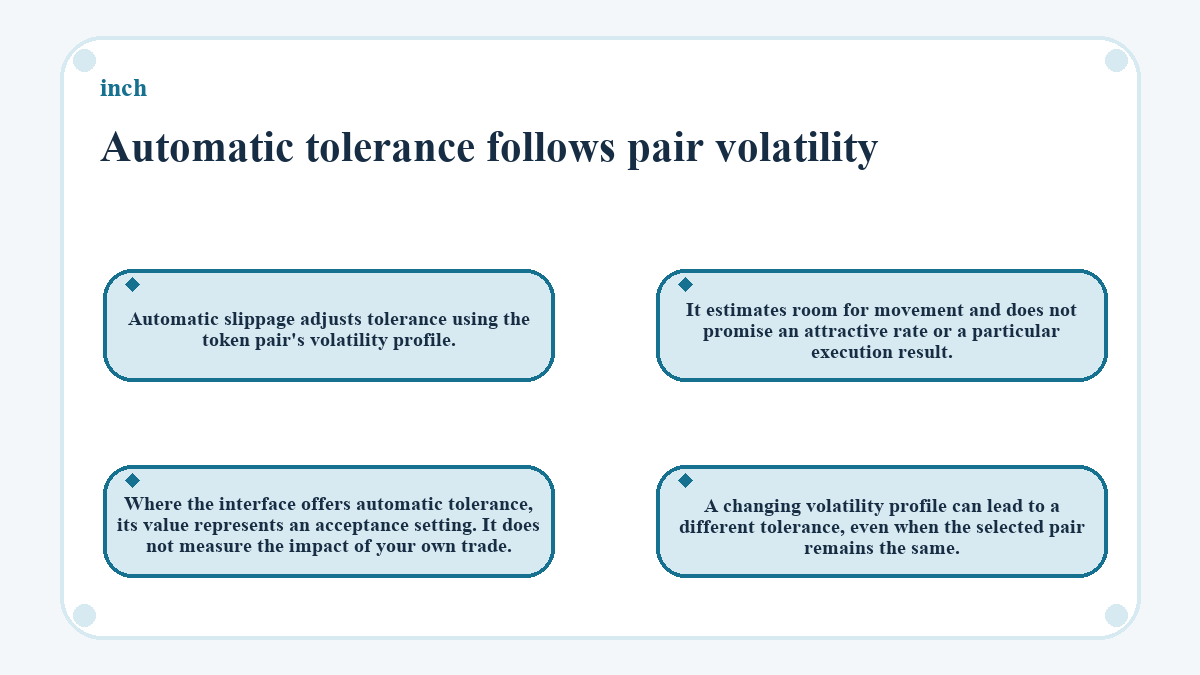
Automatic slippage adjusts tolerance using the token pair's volatility profile. It estimates room for movement and does not promise an attractive rate or a particular execution result. Where the interface offers automatic tolerance, its value represents an acceptance setting. It does not measure the impact of your own trade. A changing volatility profile can lead to a different tolerance, even when the selected pair remains the same.
Custom tolerance expresses an output limit
A custom setting specifies the deterioration that you are willing to accept relative to the quoted output. The 1inch dApp supports custom slippage tolerance up to 49%. The percentage describes permitted output variation, rather than a separate charge on the input token. For an unchanged quote, lowering tolerance raises the minimum; increasing tolerance lowers it. A fresh quote can also change the minimum without changing the percentage. The final transaction terms govern the swap. An earlier displayed amount does not freeze the available execution rate.
How should you choose a market-swap tolerance?
Choose a tolerance by deciding which minimum output you can accept, while treating quoted price impact and network fees as separate constraints.
- If the quote already shows substantial price impact, review the swap amount before widening tolerance.
- If the quote is acceptable but prices are moving, compare automatic tolerance with a custom tolerance setting.
- If a wider tolerance lowers the minimum below your acceptable output, keep the tighter limit or postpone the swap.
- If an earlier attempt missed its minimum return, reassess the fresh quote before changing tolerance.
- If token permission or gas funding is missing, address that requirement separately; tolerance does not authorize or fund execution.
When your acceptable output requires a better exchange price, waiting for a different quote or setting a Limit order addresses a different need from widening tolerance.
Reversion and transaction ordering limit the protection
The minimum-output check can reject an unfavorable execution, while a permissive tolerance leaves more room for adverse changes before the swap completes.
A reverted swap still costs gas
A market swap reverts if execution returns fewer tokens than its required minimum. Reversion undoes the swap's token exchange. Network processing still consumes gas, which remains payable even though the intended exchange did not complete. A token approval that succeeded separately can remain in place because its authorization belongs to another transaction.
Public transaction ordering can worsen the fill
A visible pending transaction can reveal its pair, amount, and accepted output to an attacker. A sandwich attack places trades before and after the victim's swap to profit from the intervening price change. A wide tolerance can allow more unfavorable movement while keeping that swap executable. A tighter tolerance restricts that room, although it does not provide universal protection against transaction ordering. Actual exposure depends on how the transaction reaches the network and the liquidity that its route uses.
Gas and submitted terms require separate adjustments
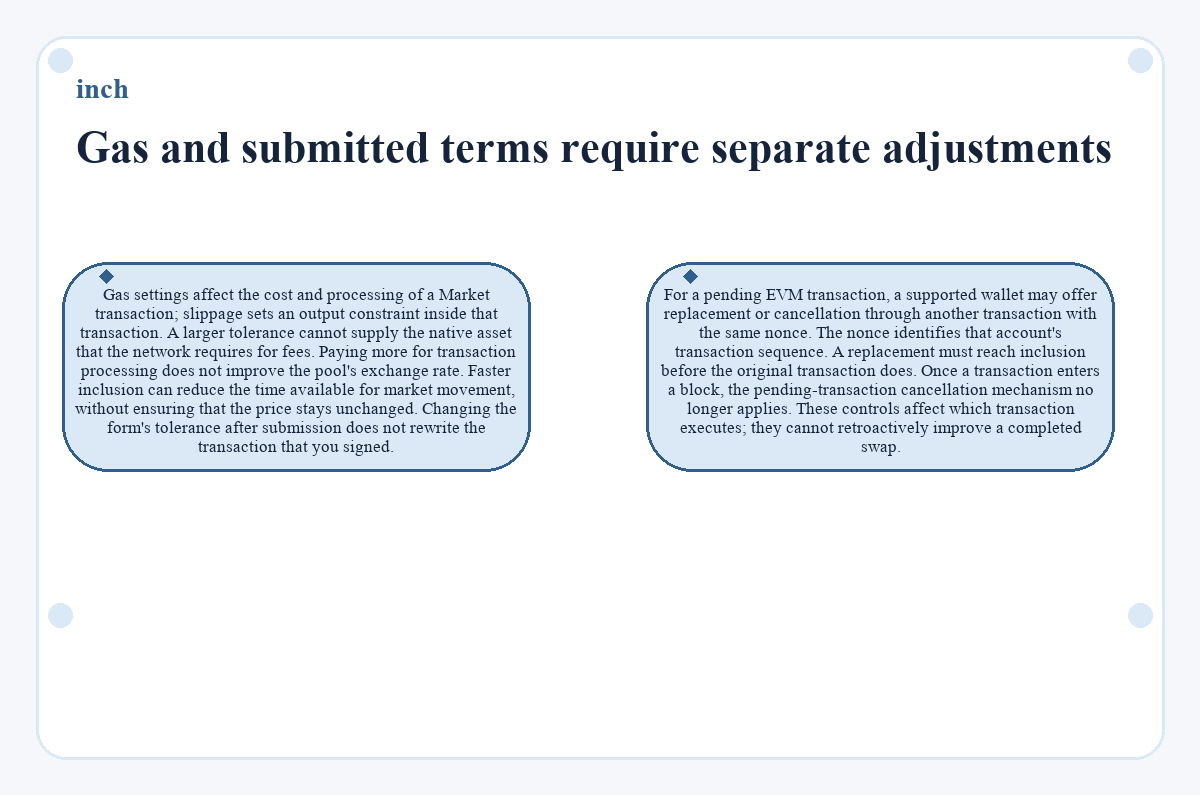
Gas settings affect the cost and processing of a Market transaction; slippage sets an output constraint inside that transaction. A larger tolerance cannot supply the native asset that the network requires for fees. Paying more for transaction processing does not improve the pool's exchange rate. Faster inclusion can reduce the time available for market movement, without ensuring that the price stays unchanged.
Changing the form's tolerance after submission does not rewrite the transaction that you signed. For a pending EVM transaction, a supported wallet may offer replacement or cancellation through another transaction with the same nonce. The nonce identifies that account's transaction sequence. A replacement must reach inclusion before the original transaction does. Once a transaction enters a block, the pending-transaction cancellation mechanism no longer applies. These controls affect which transaction executes; they cannot retroactively improve a completed swap.
Limit orders change the price objective
A Limit order sets a target exchange price and an expiration, while a Market swap seeks execution against available liquidity now. Slippage tolerance controls accepted deterioration within that Market execution. It does not turn the swap into an order that waits for a future price. A limit-order taker must choose to fill the order under its terms. Targeting a price therefore creates a different trade-off from allowing more variation around a current quote.
The streamlined Swap interface offers Fusion where available, with intent-based execution. Fusion resolvers fill orders and pay the gas for swap execution. A Limit order can remain unfilled when no taker accepts its terms. The choice concerns whether you can accept that quoted exchange with some deterioration or need a different target price.
1inch: frequently asked questions
Does changing a slippage setting alter my token allowance?
Changing slippage tolerance does not change a token allowance. The allowance authorizes a particular contract to spend tokens, while slippage limits the swap's acceptable output. Approval or supported permit mechanisms govern that spending authorization. Different trading contracts can require different approvals even when their controls appear within the same interface.
Why can a token with a transfer fee fail a market swap?
A token's transfer fee can reduce the amount available for execution and cause a swap to miss its minimum return. Fee handling depends on the token and route. The 1inch dApp cannot swap tokens whose combined internal commissions exceed 49%. A wider tolerance can accommodate the reduction where the route supports that token, but it does not remove the transfer fee or guarantee that the swap can execute.
Where can I find the executed amounts for a Terminal market swap?
The Your Trades widget lists Terminal market swaps and their transaction status. Opening a trade shows fuller details in the Account Box, including token amounts, execution price, and gas fees. Compare the completed transaction's figures with its quote. A pending entry records an unfinished transaction and cannot establish the final amount that the swap returns.
Is the chart price the rate that my market swap will receive?
A chart shows market data rather than the executable output for your particular swap. Terminal's chart helps interpret price movement, while the Market form quotes the selected direction and amount against available liquidity. The quote and its associated minimum carry the exchange terms. A chart price alone cannot establish the quantity that your transaction will return.
Which amount field can I edit before setting slippage?
Terminal lets you enter either the Total or Amount value and calculates the corresponding value in the other field. The Buy and Sell forms relate those fields to the selected trading direction. Read each value alongside its unit to distinguish spending from receiving. Slippage tolerance concerns the received output for the configured swap.