 1inch
1inch
1inch Fusion relies on resolvers to fill swaps within Dutch auction terms
- updated1inch Fusion settles a token swap when an eligible resolver (an order filler) executes its auction terms and pays settlement gas. Resolvers compete for fills that available liquidity and execution costs make profitable as the required exchange rate changes. A submitted order can fill completely, fill partly when permitted, or expire with an unswapped remainder. Token approvals and network-specific order creation can still require user-paid fees. A quote describes the opportunity to exchange tokens; a confirmed resolver fill establishes the actual exchange.
A resolver fill requires valid funding and authorization
An executable Fusion order needs valid authorization, sufficient funding, and auction terms that a resolver can satisfy on the selected network. The preparation differs between ordinary off-chain token orders and orders that require an on-chain deposit.
Balance and spending permission
On Ethereum Virtual Machine (EVM) networks, ordinary ERC-20 orders require sufficient token balance and permission for the contract that spends it. An existing allowance can cover that requirement. Supported token permit signatures can authorize spending without a separate approval transaction. Permit2 requires a token allowance to its contract, so an initial approval can still cost gas. Without a suitable allowance or usable permit, an on-chain approval costs gas. An approval permits spending, while the order signature authorizes particular exchange terms. Spending tokens or reducing the necessary allowance before settlement can prevent the resolver from filling the order.
Submission and settlement records
The ordinary EVM token flow uses an off-chain signed order that a relayer makes available to resolvers. Solana Fusion publishes the intent on-chain, locks the input in escrow, and requires a network fee in SOL at creation. Its creation transaction establishes the order, while a subsequent resolver fill establishes the exchange. Order status and confirmed fill transactions distinguish the initial submission from partial or full execution. The amounts that the receiving address actually obtains determine the settled return.
Auction terms connect your return to resolver economics
The Dutch auction can initially require a higher output for the maker, the user who creates the order.
The changing output requirement
For a fixed input amount, the auction generally lowers the required output toward the order's minimum return. The resolver evaluates the tokens that it must deliver against available liquidity and execution costs. Filling earlier can secure an opportunity before another resolver takes it. Waiting can improve the economics for the resolver, although market movement can remove that opportunity. The EVM settlement calculation also adjusts the auction rate using the current base fee and the order's gas estimates.
Eligible resolvers and execution windows
EVM settlement checks who may fill an order at the relevant time. The contract supports per-order resolver access windows and access-token checks outside the order's whitelist. Fusion's governance-dependent whitelisting, farming, and Unicorn Power-based eligibility or exclusivity are currently disabled under 1IP-89. Current resolver onboarding requires identity or business verification, a compliance survey, and access NFTs. This keeps a valid signature from implying that any address can immediately execute the trade. Auction presets carry their own duration, output amounts, and curve parameters. A preset's speed preference cannot compel a resolver to complete an uneconomic fill.
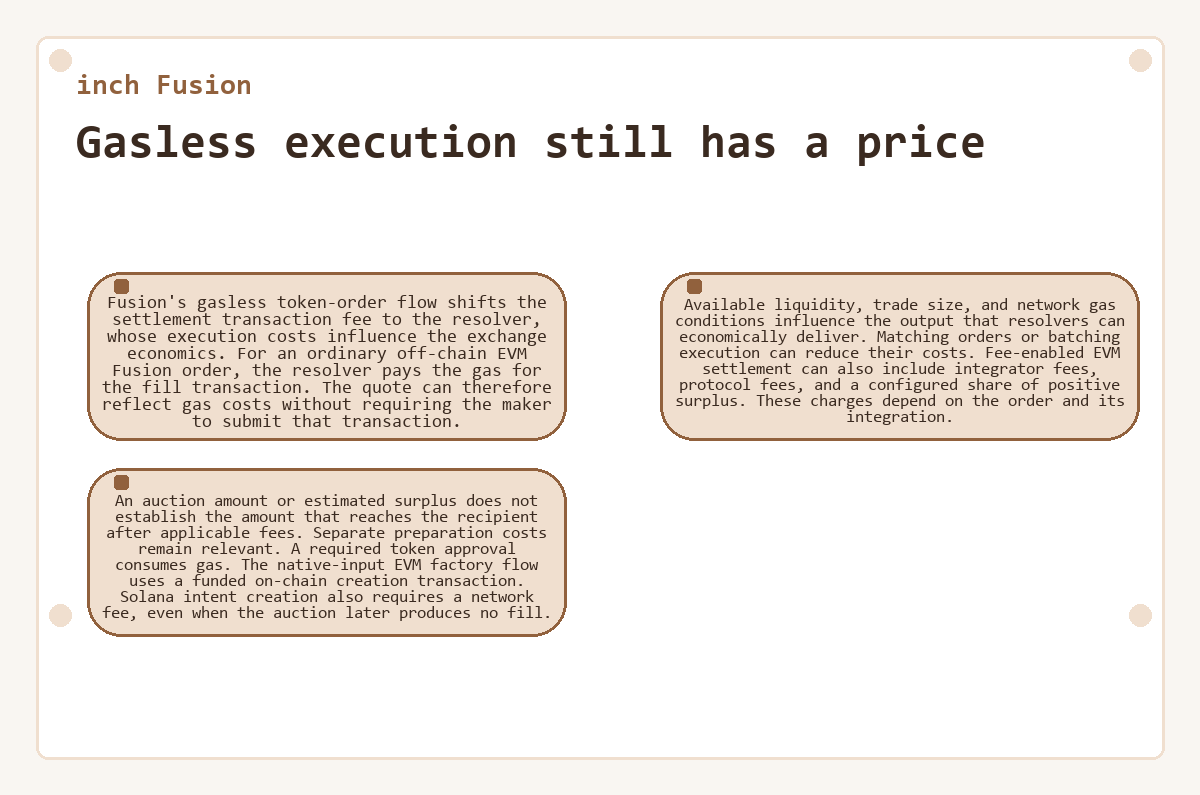
Gasless execution still has a price
Fusion's gasless token-order flow shifts the settlement transaction fee to the resolver, whose execution costs influence the exchange economics. For an ordinary off-chain EVM Fusion order, the resolver pays the gas for the fill transaction. The quote can therefore reflect gas costs without requiring the maker to submit that transaction.
Available liquidity, trade size, and network gas conditions influence the output that resolvers can economically deliver. Matching orders or batching execution can reduce their costs. Fee-enabled EVM settlement can also include integrator fees, protocol fees, and a configured share of positive surplus. These charges depend on the order and its integration. An auction amount or estimated surplus does not establish the amount that reaches the recipient after applicable fees.
Separate preparation costs remain relevant. A required token approval consumes gas. The native-input EVM factory flow uses a funded on-chain creation transaction. Solana intent creation also requires a network fee, even when the auction later produces no fill.
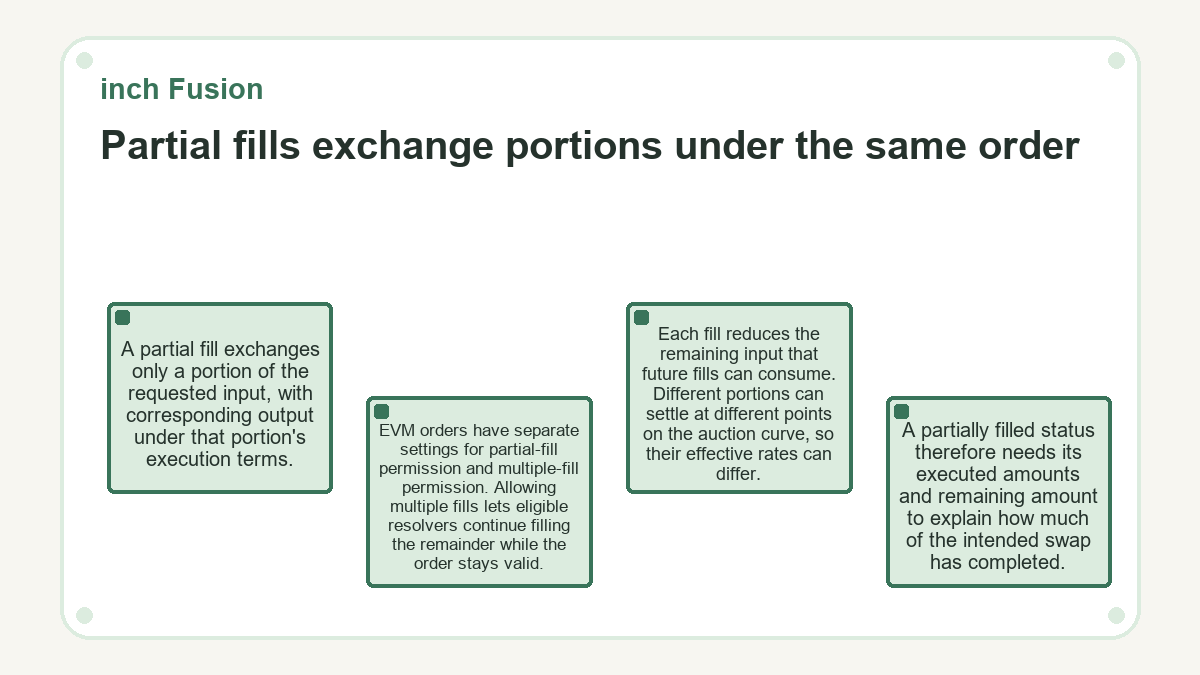
Partial fills exchange portions under the same order
A partial fill exchanges only a portion of the requested input, with corresponding output under that portion's execution terms. EVM orders have separate settings for partial-fill permission and multiple-fill permission. Allowing multiple fills lets eligible resolvers continue filling the remainder while the order stays valid. Each fill reduces the remaining input that future fills can consume. Different portions can settle at different points on the auction curve, so their effective rates can differ. A partially filled status therefore needs its executed amounts and remaining amount to explain how much of the intended swap has completed.
Reconciling a quote with settled amounts
Consider a hypothetical off-chain Fusion token order; all amounts, fill results, and market conditions in this example are illustrative. The maker has sufficient balance and allowance to sell 742 input tokens. The order permits repeated partial fills, and both eventual fills satisfy its signed price requirements. The quote reflects available liquidity and estimated gas costs, without promising a fixed settlement fee.
After the maker signs and submits the order, resolvers evaluate the auction against their execution costs. A confirmed fill exchanges 312 input tokens and delivers 468 output tokens to the recipient after applicable fees. A later confirmed fill exchanges the remaining 430 input tokens and delivers another 623.5 output tokens.
The fill records account for 312 + 430 = 742 input tokens, leaving no unswapped remainder. Independent inspection of the recipient's confirmed token transfers shows 468 + 623.5 = 1,091.5 output tokens received. That receipt total establishes this example's realized output; an initial quote or gross auction amount would not establish it.
Different liquidity or gas conditions could change when those fills become economic, or leave the order incomplete. The example assumes no separate approval or creation transaction, so the maker pays no native gas for either preparation or settlement.
Intent settlement changes exposure to transaction ordering
Off-chain EVM Fusion orders avoid the maker's publicly pending swap transaction that can expose a conventional market swap to front-running or sandwich attacks. Resolvers handle execution under the signed order's constraints, and the architecture provides MEV protection. MEV means maximal extractable value and includes gains from transaction ordering. That protection does not guarantee the auction's opening rate or eliminate the influence of changing market liquidity on whether a fill becomes viable.
The signature still authorizes a real exchange. The input asset, output asset, receiving address, and applicable terms belong to that authorization. The contract enforces the authorized terms, including an incorrect asset or recipient that the maker accepted.
Expiry and cancellation govern the unfilled remainder
An order's expiry stops further execution once its validity deadline passes, even when a resolver might otherwise find profitable liquidity. For an ordinary wallet-funded ERC-20 order, the unspent input remains in the wallet. Insufficient balance, insufficient allowance, or an invalid permit can prevent execution before expiry. A fresh quote can reflect different liquidity and gas conditions, so submitting another order creates a new set of terms.
Expiration does not undo a portion that has already settled.
The EVM Limit Order Protocol supports on-chain cancellation, which requires a transaction and its associated gas. A cancellation can stop future fills, while a fill that confirms beforehand remains completed. Checking the existing order's terminal status and executed amounts avoids treating an active remainder as a fresh full-size swap.
Escrow-funded orders require their own cancellation or cleanup mechanism to release remaining funds. On Solana, the maker can cancel through an on-chain instruction that closes the escrow and returns the remaining input. After expiry, a resolver can also cancel; the order parameters determine any cancellation premium. The EVM native-input extension, NativeOrderFactory, lets the original maker cancel and recover the remaining native funds. Eligible resolvers can also clean up expired orders. When a resolver requests compensation, cleanup must wait for the configured delay after expiry, and capped gas compensation comes from the remaining funds.
Practical questions about 1inch Fusion
-
Is staking 1INCH required before a Fusion swap?
- Swappers do not need to stake 1INCH to place a Fusion order. Fusion's resolver eligibility based on Unicorn Power from staked 1INCH is currently disabled under 1IP-89. The maker still needs the asset balance, required spending permission, and any network-specific creation fees. Holding 1INCH does not reserve a fill or oblige a resolver to execute an order.
-
Does an expired Fusion order remove its token allowance?
- Expiry does not revoke a standard ERC-20 token allowance. The deadline belongs to the order, while the allowance belongs to the token contract's spending permissions. Spending can reduce that allowance, and another approval can change it. Cancelling an order also does not itself revoke this separate permission, so the remaining allowance can outlive the trade.
-
Which identifier links a pending Fusion order to its eventual fills?
- An EVM Fusion order hash identifies the signed order, and its status record links it to fill transaction hashes. One order can have several fills, each with its own executed amounts. The order hash itself is not a blockchain transaction hash. Inspecting the linked settlement transactions reveals the token movements that correspond to its fills.
-
Can Fusion send the output to a different receiving address?
- The EVM Fusion SDK supports a receiver field that can differ from the order maker. The maker still authorizes the trade and supplies the input asset. The receiving address belongs to the order data, so it determines where the output goes. A particular swap interface must expose that control before a user can select it there.
-
Why does raising wallet gas fail to speed up a Fusion auction?
- Wallet gas settings do not control the resolver's settlement transaction for an off-chain EVM Fusion order. A token approval or native-input creation transaction may still involve the maker's gas settings because it is a separate prerequisite. Once the order awaits a resolver fill, its auction terms and eligible execution opportunities govern settlement timing.