 1inch
1inch combines decentralized exchange routing with a wider set of DeFi tools
- updated1inch routes token swaps across decentralized exchanges, which settle trades through blockchain contracts. Its aggregator compares available liquidity and can split a trade across several sources. The 1inch decentralized finance (DeFi) ecosystem includes Fusion orders, cross-chain swaps, limit orders, wallet software, and developer services. These components handle pricing, execution, and access through different mechanisms.
A quoted rate and a completed exchange describe different states of a trade. Routing finds liquidity, and settlement moves tokens under the selected method's rules. Costs and price protection therefore need to match that method, including any approval required before execution.
The short version: A split route combines liquidity sources, while the chosen execution method determines gas payment, approval requirements, and settlement conditions.
Pathfinder, settlement protocols, and wallet tools perform different jobs
The routing engine finds liquidity, trading contracts enforce exchange terms, and wallet software supplies the signatures that authorize permitted movements of tokens.
Aggregation and routing
The Aggregation Protocol brings together liquidity from decentralized exchanges. Pathfinder searches routes for a chosen token pair and trade size, including splits and intermediate assets. It compares combinations that can improve the total return and reduce execution costs. Available liquidity, token behavior, and the selected network constrain the route that it can produce.
Orders and settlement
Fusion and the Limit Order Protocol use signed orders with defined execution terms. The order creator, called the maker, sets the terms. A taker submits the transaction that fills it. Fusion uses resolvers, specialist order fillers, to compete for execution, and Fusion+ adds settlement across supported blockchains.
Wallets, tracking, and developer services
The 1inch Wallet supplies asset management and signing. The 1inch Portfolio tracks supported balances and DeFi positions, while 1inch Business offers APIs and software development kits for integrations. The 1inch Card adds crypto-funded payments under separate eligibility rules. Network and feature support differ across these products, so wallet compatibility does not establish access to every mode.
Split routes connect one swap to several liquidity sources
Several pools can contribute to one aggregated swap because the best starting price may change as the trade consumes liquidity. A trade changes available liquidity within each pool, creating price impact. Splitting the amount can spread that pressure, although additional routes also introduce pool fees and execution work. The final effective price reflects the combined output of the executed paths. Different rates within a receipt can describe portions of one fully completed swap. Some routes can include request-for-quote (RFQ) liquidity from market makers.
What costs apply to a 1inch swap?
Execution mode determines who pays transaction gas, while pool charges and any provider fees affect the economics of the token exchange.
Gas payment and token permissions
Classic aggregation swaps require the submitting wallet to pay network gas. Resolvers usually cover execution gas in the standard Swap interface. That interface has exceptions for routes involving Solana, swaps from native tokens, and some small trades that use aggregation. Gasless execution applies to the selected swap method; other interactions can still require a paid transaction.
ERC-20 token spending also requires an allowance or a supported authorization mechanism. An ordinary on-chain approval can require gas even before a resolver-funded swap. An allowance names the spender; approval for one contract does not automatically authorize a different contract. Supported permit signatures can avoid a separate approval transaction in compatible cases.
Charges within the exchange
Pool trading fees affect route prices, and some swaps also carry infrastructure fees at the API-provider layer. The taker covers applicable infrastructure fees for intent swaps and limit orders; direct aggregation can charge them to the user. Positive slippage can create a surplus when execution improves on the original quote. The 1inch Business policy assigns Classic Swap API surplus to 1inch and lets it determine surplus recipients for intent and cross-chain APIs. Improved execution therefore does not necessarily give the user extra tokens.
Fusion auctions and cross-chain escrows govern settlement
Fusion coordinates order filling through auctions, while Fusion+ links settlement on separate networks through escrow contracts that enforce the agreed exchange.
Intent orders within one network
A Fusion order specifies acceptable execution terms and an auction window. Its Dutch auction starts with a higher offered return and moves lower within the order's bounds. Resolvers compete to fill it, and an unfilled order can expire. Resolver execution provides protection against front-running and sandwich attacks, forms of maximal extractable value (MEV) extraction. It still relies on executable prices and an available resolver.
Settlement across networks
Fusion+ adds a source escrow for the maker's input and a destination escrow funded by the resolver. For each fill, a matching hashlock links the source and destination escrows. The relayer verifies the escrows before secret disclosure permits the agreed withdrawals. Settlement sends the destination asset to the maker and the source asset to the resolver. Timelocks govern cancellation and recovery if completion stalls. In the web swap interface, the tab must remain open so it can share the secret needed for completion. Partial fills can leave part of the requested exchange unfilled.
Limit orders keep a target price without locking the balance
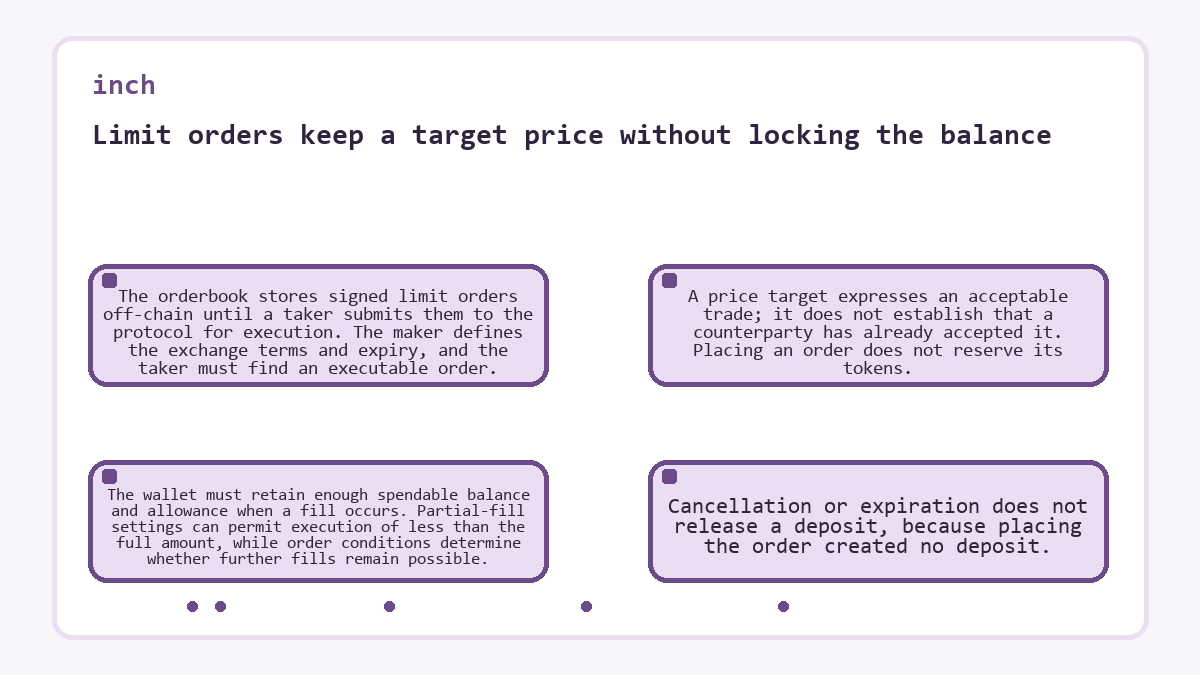
The orderbook stores signed limit orders off-chain until a taker submits them to the protocol for execution. The maker defines the exchange terms and expiry, and the taker must find an executable order. A price target expresses an acceptable trade; it does not establish that a counterparty has already accepted it.
Placing an order does not reserve its tokens. The wallet must retain enough spendable balance and allowance when a fill occurs. Partial-fill settings can permit execution of less than the full amount, while order conditions determine whether further fills remain possible. Cancellation or expiration does not release a deposit, because placing the order created no deposit.
Aqua liquidity provision and 1INCH governance have separate purposes
Aqua lets liquidity providers allocate virtual balances to multiple strategies using assets that they continue to hold themselves. The protocol transfers provider tokens only when a swap fills. Those allocations do not reserve separate inventories. Earlier fills, wallet transfers, or insufficient allowance can prevent later commitments from settling. Access to particular routing integrations and taker functions also depends on their screening and credential requirements.
The 1inch DAO enables 1INCH stakers to vote on protocol parameters. Staking supports governance participation, while a swap authorization permits a particular token exchange. These are separate uses of the ecosystem: governance concerns protocol policy, and an order signature records trade terms.
Swap and Terminal expose different amounts of trading detail
Swap emphasizes intent-based token exchanges where supported, while Terminal exposes Market and Limit modes, charts, routing information, and configurable trading settings on supported Ethereum Virtual Machine (EVM) networks. The simpler interface suits a quoted exchange. Terminal adds context for inspecting how liquidity and order terms affect a trade. Feature availability follows the particular network, trading mode, and jurisdiction. Users in the United Arab Emirates cannot use 1inch products for swaps, trades, sending tokens, card purchases, new positions, staking, delegation, or voting. They can still view assets, cancel orders, close positions, withdraw, unstake, claim rewards, and recover or export wallets.
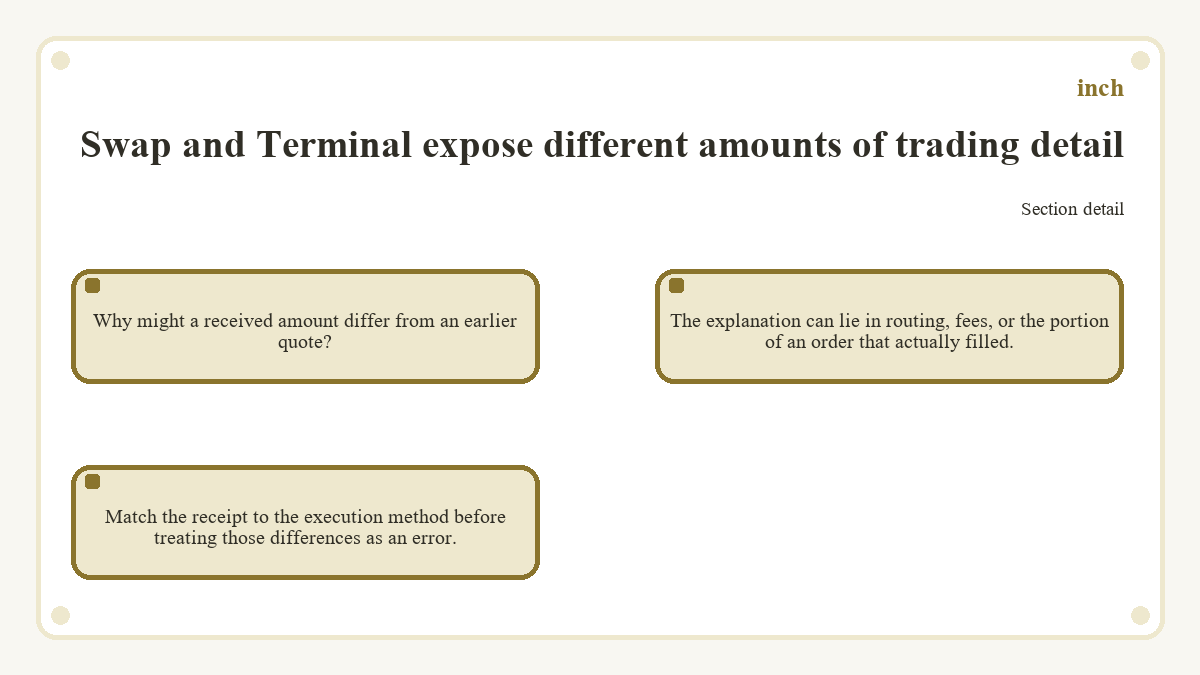
Why might a received amount differ from an earlier quote? The explanation can lie in routing, fees, or the portion of an order that actually filled. Match the receipt to the execution method before treating those differences as an error.
- When a receipt shows several routes, use their combined output instead of one pool's execution rate.
- For a partial fill, compare the output with the filled amount and keep the unfilled remainder separate.
- When a resolver covers gas, account separately for any approval transaction and the fees within the exchange.
- For cross-chain settlement, assess the destination asset on the selected destination network.
- If no route appears, network support alone does not establish support for that token pair and execution mode.
In the 1inch dApp, a sanctioned-token classification blocks actions with that token, and a restricted-token classification blocks swaps. Other risk categories can produce warnings without blocking trading. The custom-token checks in the decentralized application use 1inch Shield.
Things people ask about 1inch
-
Is an exchange account required for a wallet swap?
- A standard wallet swap does not require a separate exchange account. The decentralized application uses a supported wallet for authorization and signing. This differs from 1inch Business, which has an account system for developer services. A wallet swap still needs the permissions and available liquidity that apply to the selected trade.
-
Why can a limit order stay open after a chart reaches its price?
- A chart price does not guarantee that a taker can profitably execute the order. Chart data can differ from the actual on-chain rate that the fill requires. Takers also consider gas costs, available liquidity, and their execution margin. An order can therefore remain open even when a displayed price touches its target.
-
Can a failed Classic swap still consume gas?
- A reverted Classic swap can still consume gas because the blockchain has processed the attempted transaction. Reversion prevents the swap from completing below its enforced minimum output, but it does not refund the execution fee. An unfilled off-chain intent order follows a different execution model; it is distinct from a reverted wallet-submitted transaction.
-
Are watch-only wallet balances available for spending?
- A watch-only balance has no spending authority because the wallet contains only the public address. Sending or swapping requires the owner's signing credentials, or a connection to a device that holds them. Paying an activation fee cannot turn someone else's public address into a wallet that you control.
-
How can a received token be absent from the wallet display?
- A wallet can hide a received token even when the blockchain records it at the correct address. Token lists and network selection control what the interface displays. For supported contract-based tokens, importing the correct token contract on the destination network can reveal the balance. An approval transaction alone does not establish that the swap delivered tokens.
-
Does reinstalling 1inch Wallet restore access to its funds?
- Reinstalling the app does not automatically recover the keys that authorize spending. Recovery requires the original seed phrase or private key, a previously created compatible backup, or reconnection to a supported hardware wallet that still holds the original keys. Adding only the public address restores a watch-only view. Neither a displayed balance nor reinstalling the software enables support staff to recreate a missing seed phrase.
-
What information does Portfolio need to track an address?
- Portfolio can track an address from its public wallet address without a seed phrase or a spending signature. It reads supported asset and position data to display balances and performance. Coverage depends on the networks and protocols that it supports, so a tracked portfolio can differ from a wallet's own display without any token transfer.
-
Where is the 1inch Card available?
- The card requires residence in a supported country and completion of its eligibility requirements. Availability primarily covers eligible European Union countries, with conditions varying by location. Access to wallet swaps does not establish eligibility for the card. Its payment and conversion functions have their own onboarding requirements and fee terms.